September 21, 2026
What is Soundproofing Anyway?
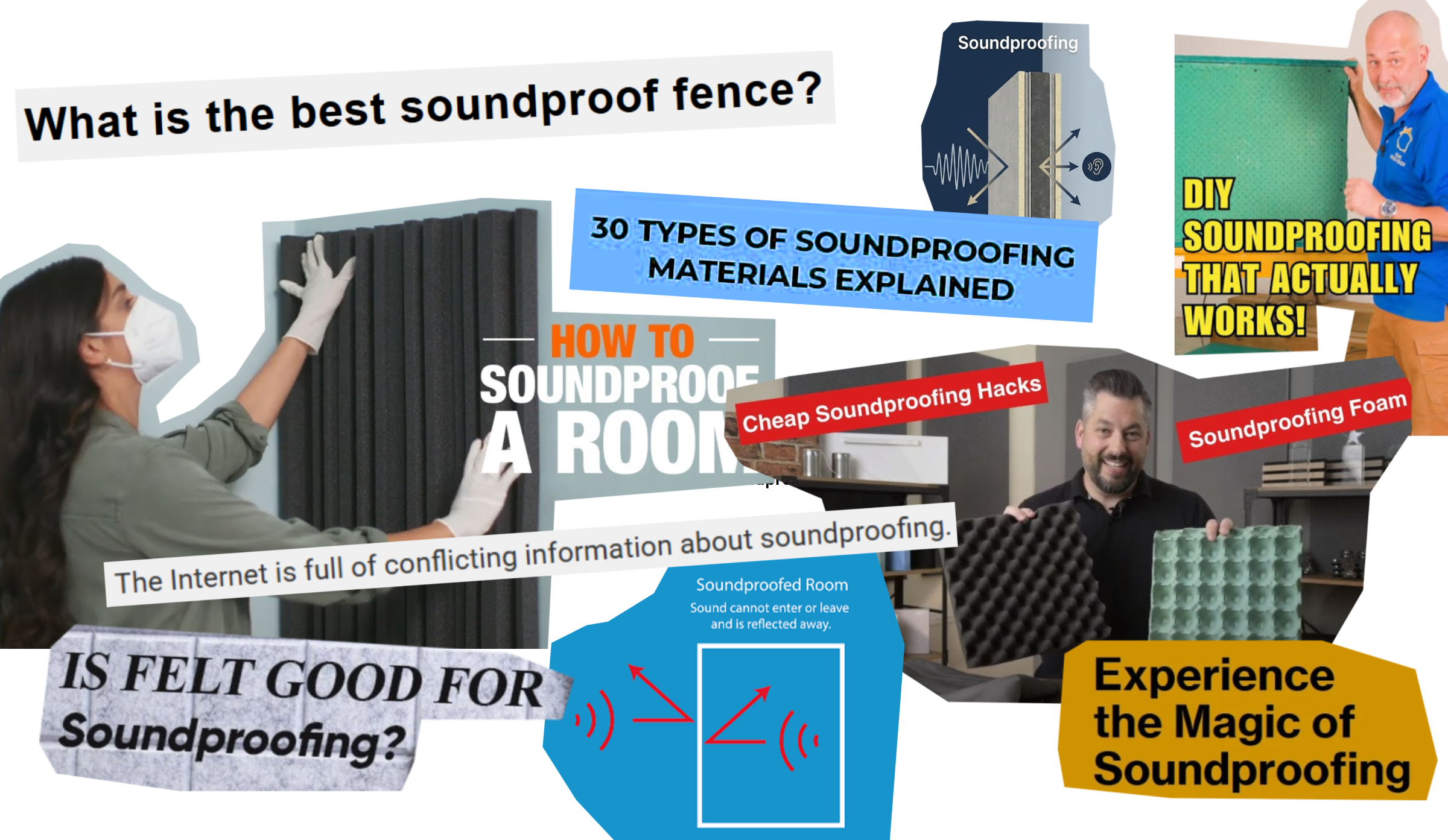
Since I created a Google business profile for From the Sound Up, I get to see the search keywords people use to find my website. Looking at the results this week, I was surprised that the top keyword is ‘soundproofing’ or some variation on that word. It surprised me because I don’t use the term myself and I have never heard my colleagues in the acoustical consulting world use it either. ‘Well,’ I thought to myself, ‘I had better find out what it means, because people want it and they are finding me, and I’d better be prepared to talk to them about it!’
Talking About Sound
I may have felt surprised to see an unfamiliar term at the top of my search keyword ranking, but I’m not surprised to encounter vague or confusing words related to building acoustics. That is because our vocabulary for describing environmental sound is quite limited (in English at least), and it relies a lot on loanwords from the other senses. When I was working on my graduate school thesis, I compiled a long list of terms music critics use to describe concert hall acoustics.The list included visual words like bright and shimmering, tactile words like dry and velvety and even gustatory words like chocolatey and buttery.
There is a precise and consistent vocabulary acoustical consultants use, but it differs from the everyday words people use to describe sound in buildings, which can make it hard to communicate. My goal as a consultant is not to educate every client on how to use the ‘correct’ technical terminology, but it is important to at least make sure we’re talking about the same thing.
Marketing Noise
To educate myself on what soundproofing means, I did a web search for the term. The top results were for product manufacturers selling a diverse array of products, ranging from blown-in wall insulation to felt adhesive panels to wood pulp board to metal drywall clips. Most of these products were advertised as materials for keeping sound out of a space, but a few were also advertised as for absorbing sound inside a space. Some were marketed as one-stop, cure-all solutions and others as components in a more complex system. One website that contained a lot of marketing noise claimed, ‘The Internet is full of conflicting information about soundproofing. Don’t let yourself become confused by all the unnecessary marketing noise.’

A waterproof fabric. Image: Birch Landing Home / Creative Commons
My conclusion from the web search was that soundproofing is ambiguous as a technical term but very effective as a marketing term because it rolls off the tongue and seems to promise a perfect solution. A waterproof jacket is completely impenetrable to water, so by the same logic a soundproofed room should be completely impenetrable to outside sound. The promise of ‘proofing’ is misleading, however, because completely preventing the transmission of all sound energy from one space to another is effectively impossible. Doing so in theory would require building one room levitating inside another room, with no structural coupling at all, and could not have any door or other opening, so it would be impossible to enter or exit.
Soundproofing or Sound Isolation?
Instead of ‘soundproofing,’ acoustical consultants use the term ‘sound isolation’ to describe acoustical separation between spaces, and ‘sound absorption’ for reducing sound buildup inside a space. The architectural materials used to improve sound isolation are different from those used to increase sound absorption, but because the term soundproofing is used to describe both, there is a high risk of buying a product for the wrong application. There is a common misperception that covering the walls and ceiling of a room in eggcrate foam, a sound-absorbing material, will reduce noise ingress from the adjacent room, but it does not contribute to sound isolation at all.
‘Isolation’ is a more honest word for describing the practical application of reducing sound transmission between spaces, because it evokes relative separation rather than the absolute separation ‘proofing’ impractically promises. Someone who lives in an isolated village is not prevented from traveling to the big city, someone who is socially isolated still has the potential to make new friends, and similarly sound that is isolated is not completely kept out.

Flower’s Cove, an isolated village in Newfoundland. Image: torbenbrinker / Creative Commons
Sound Isolation or Sound Insulation?
The term ‘sound insulation’ is sometimes used in place of sound isolation, but it refers more precisely to insulation products, such as fiberglass batts, that are added to wall or ceiling cavities to improve the sound isolation of the whole assembly. In other words, insulation can improve sound isolation, but not as a standalone product. If it is added to a wall cavity, it will dampen resonance inside the cavity and reduce the amount of sound energy transmitted, but if it is mounted to the outside of the wall, it will not have the same effect.
How Much Is Enough?
Because perfect sound isolation is not only impractical but impossible, I work with clients to set a realistic goal for how much sound should be audible in their space. For retrofits and renovations, being realistic requires understanding who will be using the space, how they will be using the space, what kind of noise is expected next door, how loud the HVAC system is, what limitations the existing architecture has, and what the project budget is.
In some spaces, it may be acceptable to hear speech noise from next door as long as it is quiet and not distracting. In spaces where privacy is critical, for example a talk therapy office or a medical clinic consultation room, it may be acceptable to hear faint speech noise as long as it is very quiet and not intelligible. In even more sensitive spaces, for example a chamber music recital hall or recording studio, outside noise will likely need to be isolated to a level beneath the HVAC noise floor.
Designing for Sound Isolation
Once a realistic goal is set, I get to work developing a sound isolation design to meet the goal. Achieving the goal in a new building design can’t be done with a single product, and it’s also rare that a single product will solve a sound isolation issue in a retrofit. The design solution typically requires specifying an assembly of architectural products along with installation instructions to avoid gaps and, in some applications, rigid structural connections.
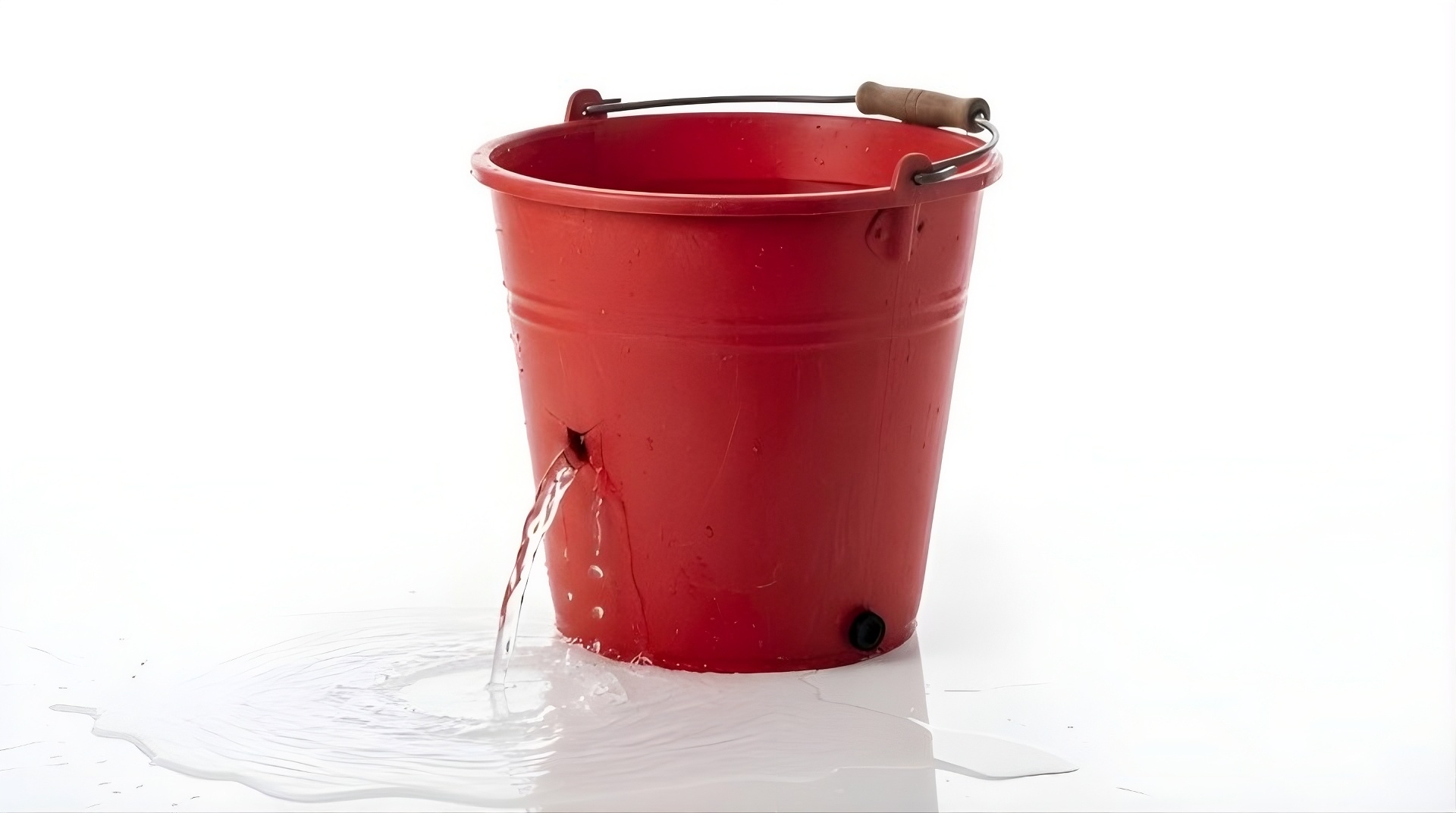
A leaking bucket.
While adding or removing sound-absorbing finishes has an incremental effect on the sound level inside a room, removing a single component of a sound isolation design can cause the acoustical performance of a partition to completely fail. An analogy I often share with clients is that of a metal bucket. It’s important to construct the bucket with a thick enough gauge of metal to hold the water, but it doesn’t matter how thick the gauge is if there’s a hole in the bucket. The water will just leak out. Similarly, you can build a hefty wall with multiple layers of gypsum board on structurally separated studs and batt insulation in the cavity, but if there’s a gap between the top of the wall and the ceiling deck, you will still be able to hear everything in the next room.
How I Can Help
If you are facing a sound isolation challenge, I can help you investigate the problem, set a goal and develop a solution that a contractor can take and implement.
Get in touch with me to talk about your project!